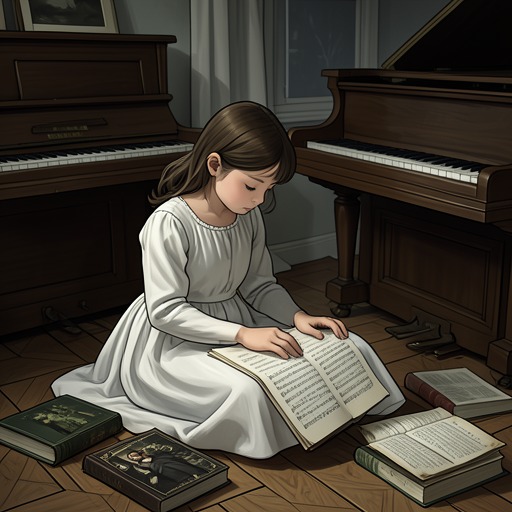
Sofia’s first Chopin performance for her father
A Gentleman in MoscowSofia’s first Chopin performance for her father turns an unexpected display of musical skill into a disclosure of the feeling beneath it. In the ballroom of Hotel Metropol, the seventeen-year-old plays the opening of Chopin’s Opus 9, No. 2, in E-flat major with such delicacy and expressive command that Count Alexander Ilyich Rostov is moved from recognition to astonishment. When he asks how she found the piece’s heartache, Sofia explains that she thinks of her mother and of the few memories of her that are fading. The performance reveals not only what Sofia can do, but what she brings to the music.
The performance and its effect
The instructor joins Sofia on the bench and gives her the cue to begin. She straightens her posture, lays her fingers on the keys, and starts with the utmost delicacy. At the first measure, the Count takes two steps backward. The notes are so familiar that he imagines he would recognize them after thirty years away from them, even in a passing encounter on a train or amid the streets of Florence. The music is Chopin’s Nocturne, Opus 9, No. 2, in E-flat major.
As Sofia completes the first iteration of the melody in a perfect pianissimo and enters the second, with its suggestion of increasing emotional force, the Count retreats another two steps and finds himself sitting in a chair. The sequence gives his response a physical form: the music does not merely confirm that he knows the composition; it unsettles him enough to make him withdraw and sit. Its gradual unfolding also lets the narrative distinguish recognition of the notes from astonishment at the person playing them.
From pride to astonishment
The Count already has ample reasons to be proud of Sofia. He takes pride in her success at school, her beauty and composure, and the affection she receives from the people who work at the hotel. But he understands that this response is different. Pride, as he sees it, carries the satisfaction of having anticipated another person’s special qualities. Listening to Sofia, he leaves that familiar knowledge behind: he is not congratulating himself for having recognized her gifts, but encountering an ability he had not known she possessed.
His astonishment has several parts. He did not know that Sofia could play the piano at all; he is also struck by her command of the composition’s primary and subordinate melodies. Most striking to him, however, is her musical expression. Technical mastery alone, he reflects, does not guarantee the ability to communicate a composer’s feeling. Sofia’s performance does more than render the notes correctly: its sensitivity makes the work’s emotional content available to a listener. The scene therefore makes the performance an act of communication, not simply a demonstration of technique.
The source of the music’s feeling
The Count recognizes the passage as an expression of heartache and wonders how a seventeen-year-old could play it with such feeling. He tells Sofia that, although he has never played an instrument, he understands something of music; the emotion in her opening measures suggests to him that she has drawn on sorrow within herself. His question turns the encounter from an assessment of skill toward the personal source of her interpretation.
Sofia answers by explaining what she has learned from Viktor Stepanovich Skadovsky: before playing, she looks for an example of a composition’s mood within her own heart. For this piece, she thinks about her mother. Her few memories of her seem to be fading, and she begins to play from that thought. The explanation connects the music’s expressive force to a specific loss in Sofia’s experience without reducing her performance to mere imitation of grief. She has taken an idea taught by her instructor and found within it a feeling that is her own.
Significance
The scene changes what the Count knows about his daughter. He had been proud of qualities visible in her daily life and recognized by the hotel community; the nocturne discloses a capacity that had been hidden from him. It also gives Sofia’s musical talent an emotional dimension: her ability to convey Chopin’s heartache is linked to her effort to hold on to memories of her mother as those memories recede.
The father and daughter reach this disclosure by different routes. The Count first hears an extraordinary performance, interprets its feeling as evidence of private sorrow, and asks what lies behind it. Sofia then names the memory that guides her playing. The scene’s movement from familiar music, to the Count’s bodily retreat, to Sofia’s account of her mother makes artistic revelation inseparable from personal recognition: he discovers her as a musician, while she lets him see the feeling from which this particular performance begins.